> For the complete documentation index, see [llms.txt](https://docs.pushpushgo.company/llms.txt). Markdown versions of documentation pages are available by appending `.md` to page URLs; this page is available as [Markdown](https://docs.pushpushgo.company/subscribers/segments/create-segment.md).
# Create Segment
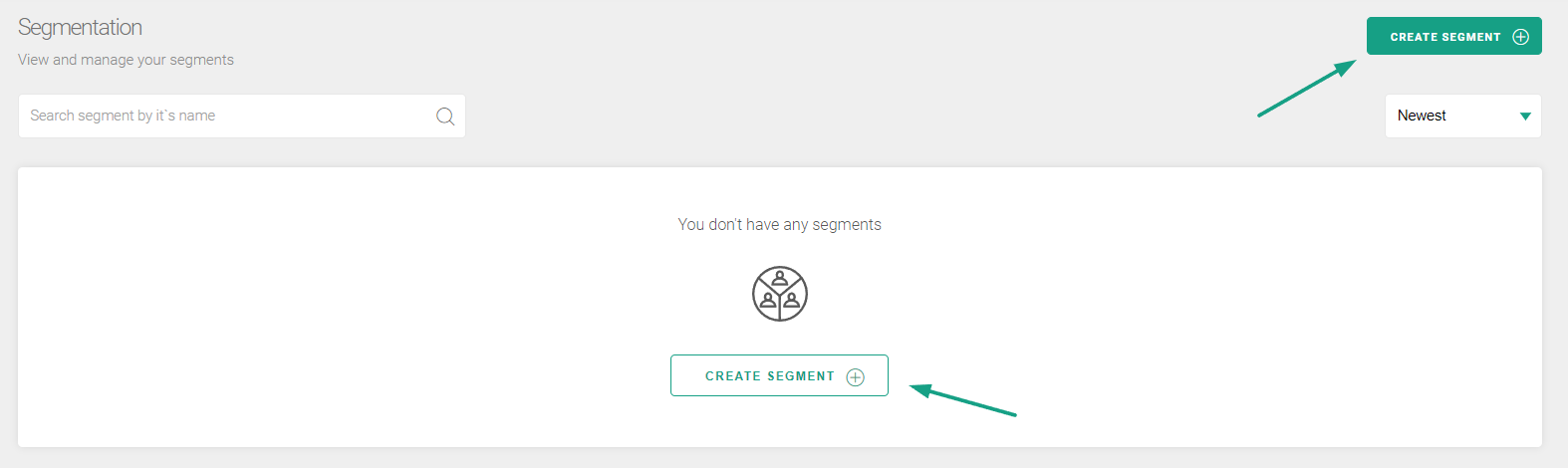
The Segment List will be empty until you create the first segment. You can do it by clicking one of the two buttons:
In the creator, you can declare conditions to extract subscribers.
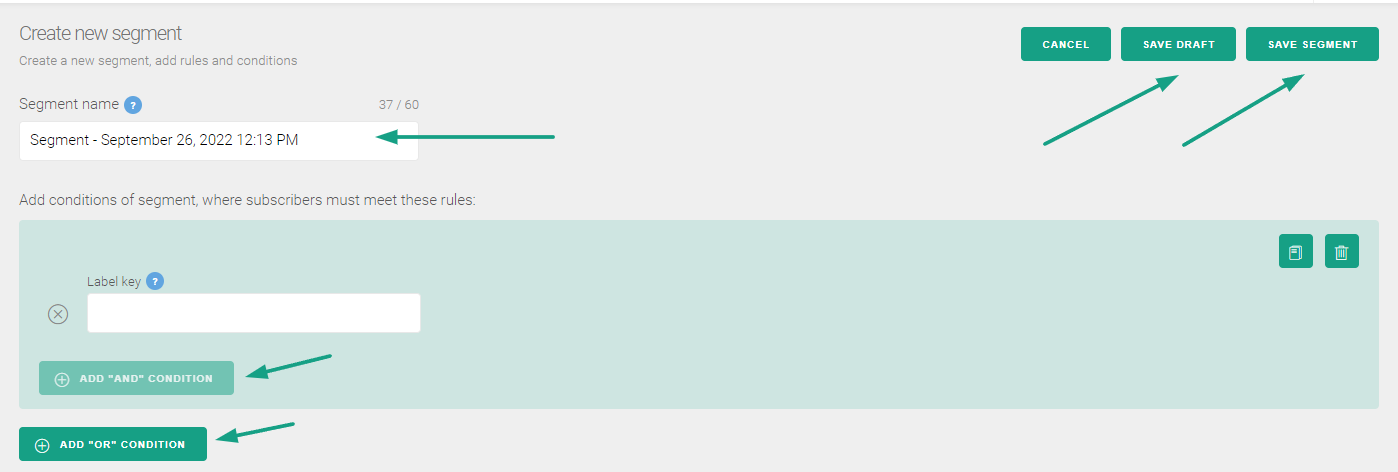
Below you can see a segment creation view:
The segment name will be filled in automatically with the date and hour of creation. You can change it and add details essential for the segment using up to 60 A-Z, a-z, 0-9, and - \_ : + . sings and space.
Below the name, you’ll find the core part of the creator: ascribing the conditions based on [labels](/subscribers/labels.md).
Just to recap: a single label has the “key value” form. Similarly, segments have a “Field” (Label Key), a matching operator (ex. “Equal”), and a specific “Label Value”.
You can add new conditions in groups, using the 'AND' strategy (green field). Each new group will be preceded by the 'OR' strategy.
{% hint style="warning" %}
Remember! A segment must consist of at least one condition.
{% endhint %}
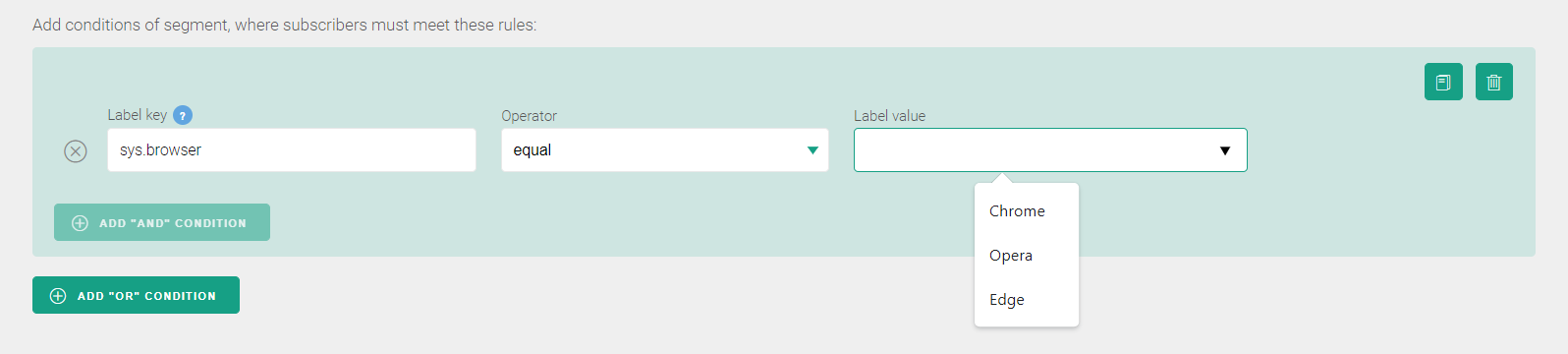
When you create conditions based on labels, you'll get a number of operators you can use. For example, 'equal' and 'not equal' will include subscribers who have (equal) or don't have (not equal) a specific label connected.
When you choose a 'Label key' and an operator, you can pick one of the existing 'Label values' from a list.
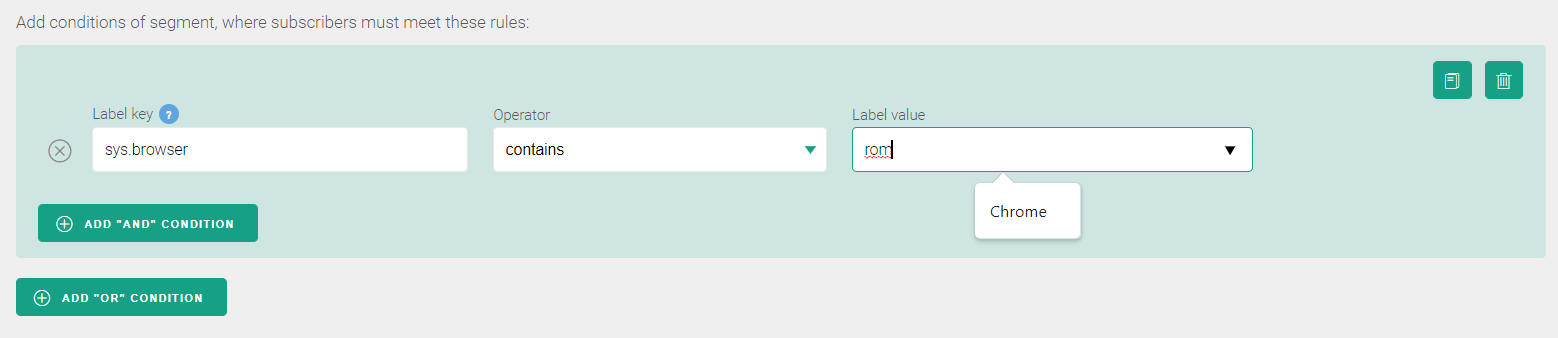
Another pair of operators is 'contains' and 'not contains'. It allows you to use suggestions from a list or type in the value you require. With these operators you can see if labels in a selected 'Label key' contain the phrase you wrote down, or not.
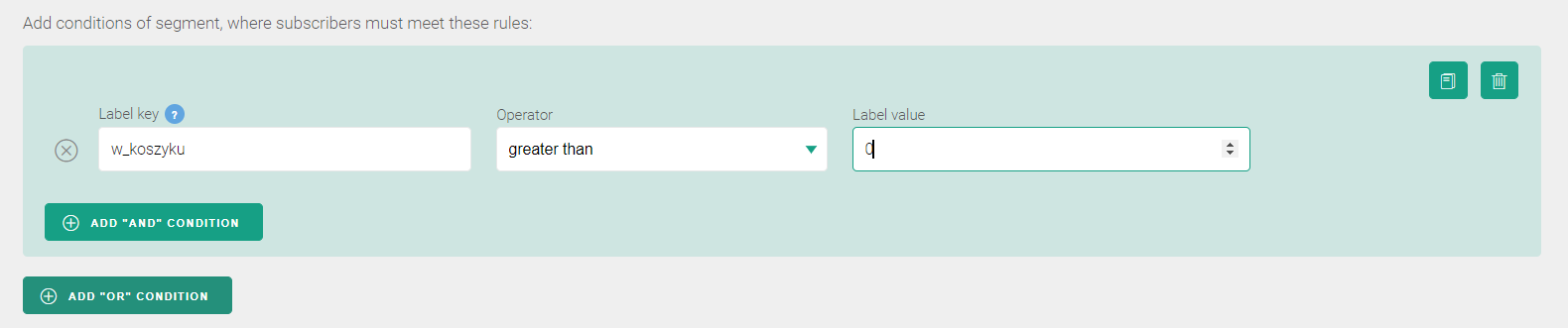
There are also numerical operators: 'greater than', 'greater than or equal', 'lower than', 'lower than or equal'. They refer to numerical values in 'Label value'.
Example: if your 'Label key' is 'Cart', you can create a condition to see if a subscriber has more than 0 items in their cart. Use 'greater than' operator.
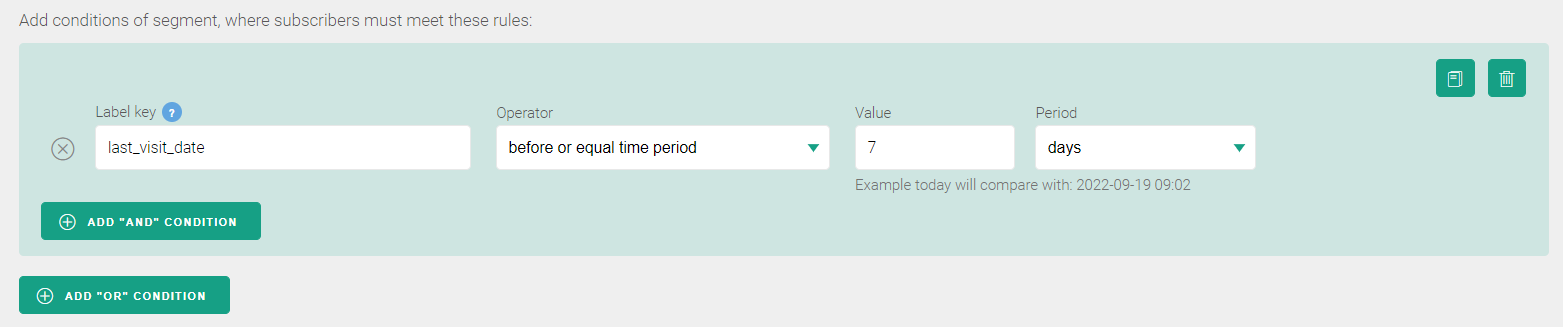
The last pair of operators are ones addressing time. They are used with labels with 'Label value' presented in a form of a date. Those are 'after or equal time period' and 'before or equal time period'. By defining a period to classify labels on subscribers, you can see if an action took place before or after that. The image below shows that only the subscribers who entered your website in the last seven days will be included in the segment.
After you create a segment with all required conditions you can save it as a draft (click 'Save draft' in the top-right corner of the creator) or count it and allow usage in a campaign by clicking 'Save'.
After the segment is counted you'll see the number of subscribers meeting its criteria. This group will receive a campaign targeted to this segment.
A saved segment will show on the Segment list. A green color indicates that it's correctly counted and ready for usage. If it's still being counted, it will be highlighted in yellow. Drafts are marked in grey.