> For the complete documentation index, see [llms.txt](https://docs.pushpushgo.company/llms.txt). Markdown versions of documentation pages are available by appending `.md` to page URLs; this page is available as [Markdown](https://docs.pushpushgo.company/subscribers/segments.md).
# Segments
{% hint style="info" %}
You can create up to 5 segments in each project.
{% endhint %}
Segments allow you to create conditions based on [Labels](/subscribers/labels.md). The latter determine if a subscriber belongs to a given segment.
Each segment has its properties:
\- **name** - unique within a project
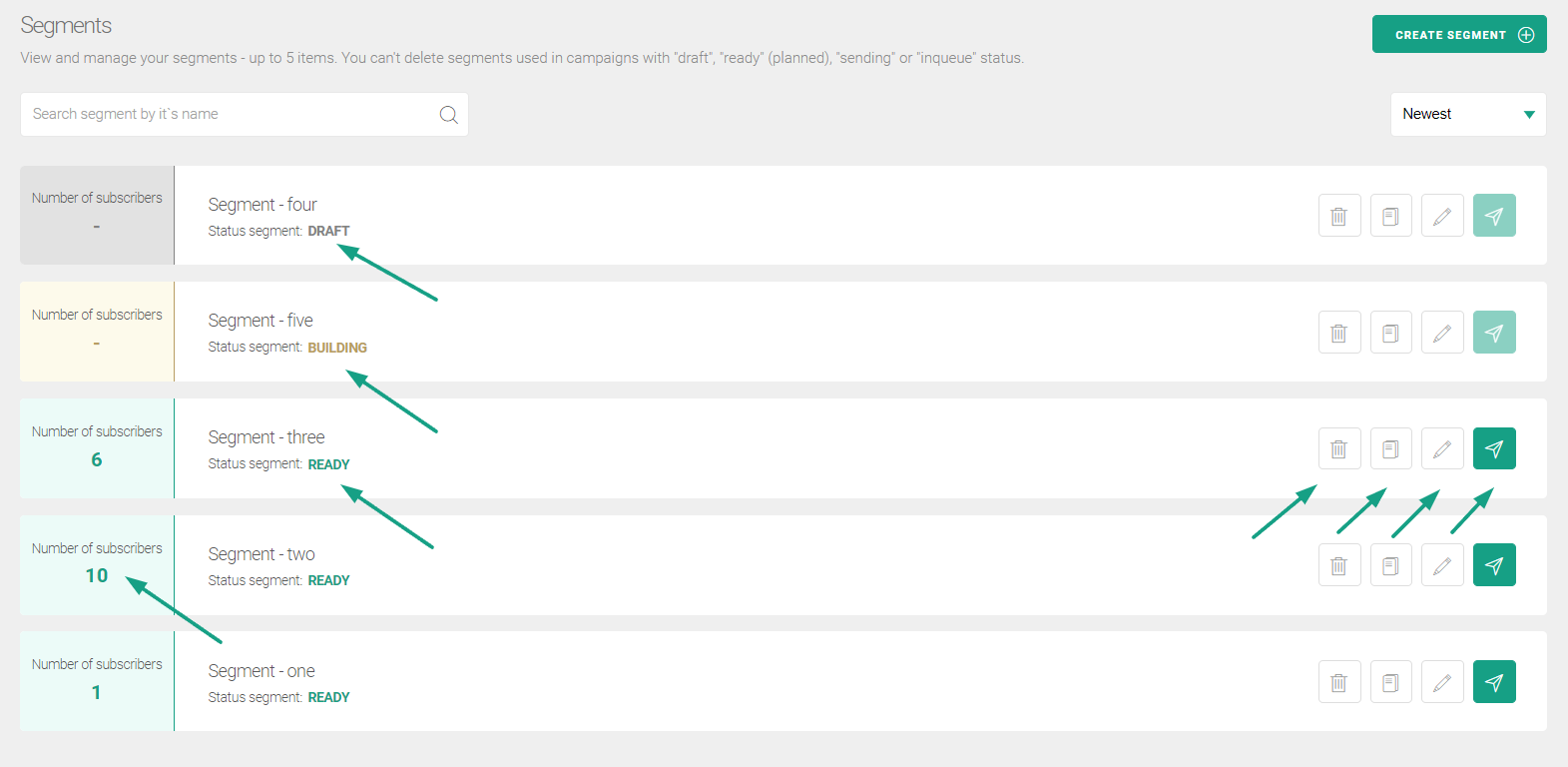
\- **status** (draft, building, or ready) - every created segment is in the ‘building’ status and becomes ‘ready’ after it's calculated
\- **audience** - a precise number of current subscribers in a segment
After defining a segment, the building process begins. It may take a while - we need to scan each subscriber in the base and match them with the segment conditions. When the process ends, the segment switches to ‘ready’. It displays the number of subscribers within it. You can send messages to them.
Every time you change or add labels to a subscriber, it causes changes in the segments. They are rebuilding in real-time, following new subscriber descriptions per labels.
Segments allow you to send a push to a selected group much faster than [other targeting options](/campaigns/push-campaign.md).
You can find segments defined for a project in the Segments view.:
You can search segments by name or sort them, either alphabetically or chronologically (by creation date). The view allows you to delete, copy, and edit segments. You can create a campaign for a given segment with a ‘ready’ status by clicking on a green button with an arrow sign.
Deleting a segment won't be possible if it’s currently used in a planned campaign, a saved draft, or in a campaign that’s being sent. It prevents unnecessary complications and errors in campaigns.